
The Mutability Problem
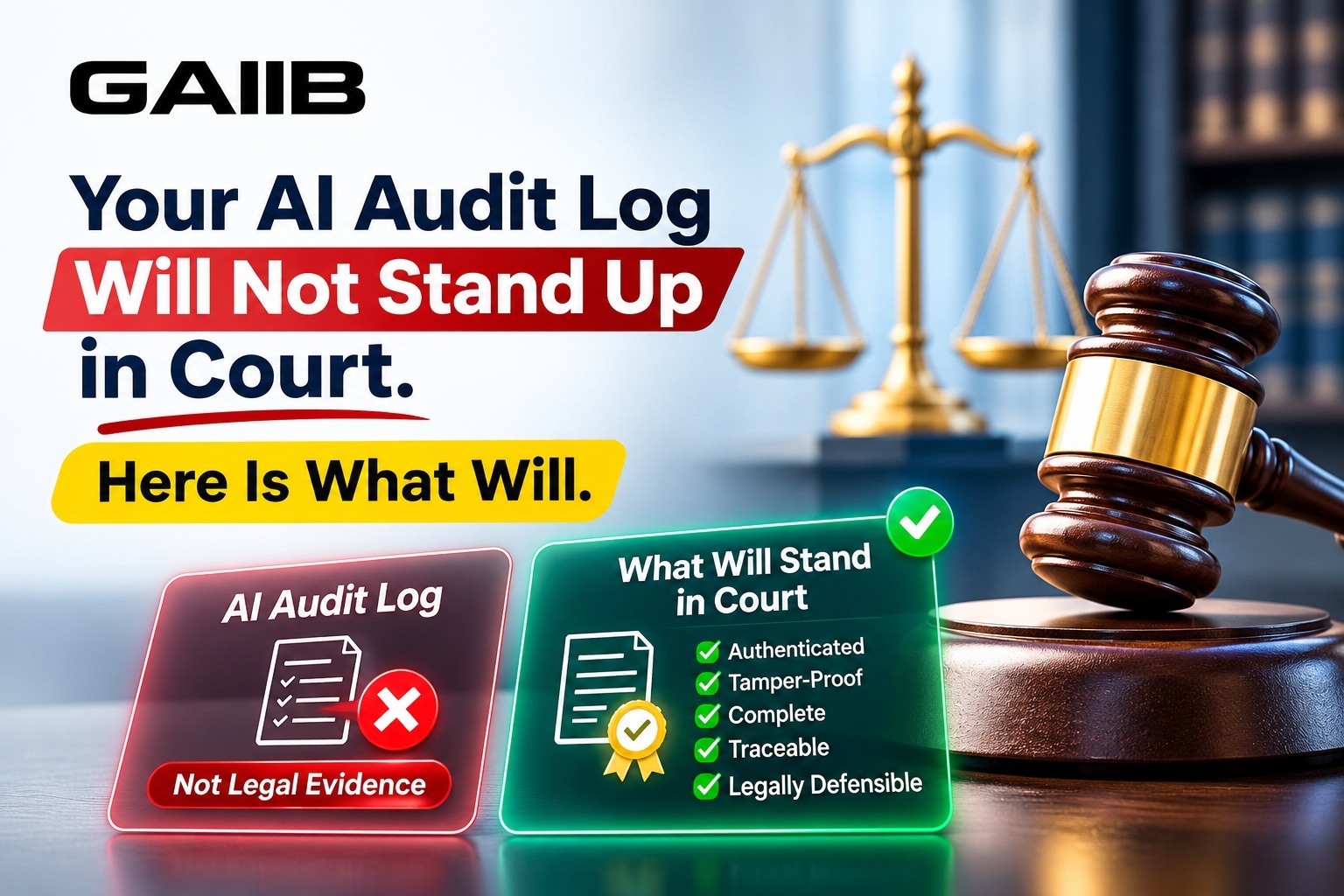
When regulators and courts evaluate evidence, the first question is not whether the evidence is accurate. It is whether the evidence could have been modified after the event it purports to document. A piece of evidence that could have been altered — even if it wasn't — is not tamper-proof evidence. It is a record subject to challenge.
Your database audit logs are stored in systems your engineers have administrative access to. This is a technical fact, not an accusation. The same database administrator who can restore a failed transaction can, in principle, modify a log entry. The same systems team that can debug a production issue can, in principle, alter the timestamps on log entries.
This is not speculation. It is the standard question that opposing counsel and regulatory investigators ask about any electronic record: "Who has write access to this system? Could this entry have been modified after the inquiry was received?" For a standard production database log, the honest answer is: yes.
What Section 65B of the Indian Evidence Act Actually Requires
Section 65B of the Indian Evidence Act governs the admissibility of electronic records as evidence. It is not sufficient for an electronic record to exist. It must be produced by a computer system that was used regularly for storing and processing information in the ordinary course of activities, and the output must be a reproduction of the information contained in that system.
The implicit requirement in Section 65B is reliability — the court must be satisfied that the electronic record accurately reflects what the computer system recorded. If there is any basis to challenge whether the log entry could have been modified after the fact, the admissibility of that record as primary evidence is weakened.
A cryptographic hash chain — where each evidence record contains the hash of the previous record, such that any modification to any record changes every subsequent hash — satisfies Section 65B's reliability requirement in a mathematically verifiable way. Any modification to any point in the chain is immediately detectable by anyone who checks the chain. The evidence is not just claimed to be tamper-proof. It is provably tamper-proof.
What the QCB AI Guideline's Incident Reporting Requirement Creates
In the event of a serious incident, the entity should report to the QCB immediately after a causal link between the AI system and the incident is established, or its reasonable likelihood. Agoujgal
When a QCB-licensed institution reports an AI incident to the QCB, the regulator will ask for evidence of what the AI system was doing at the time of the incident. They will ask for governance records, decision logs, and compliance evidence. If the institution's evidence is a standard database log that any engineer could modify, the regulator's next question is obvious: how do we know this hasn't been altered since you became aware of the inquiry?
The institution with a cryptographic hash chain anchored on blockchain — where every evidence record is verifiable at polygonscan.com without contacting the institution — does not face this question. The evidence speaks for itself.
The Legal Admissibility Opinion
The critical development in GAIIB's legal architecture is the formal opinion from Sulay Mitra and Associates confirming that GAIIB evidence records qualify as electronic records under Section 65B of the Indian Evidence Act and Section 43A of the Information Technology Act 2000.
This opinion transforms GAIIB evidence from a technical governance tool into a legally admissible instrument for regulatory proceedings. When a DPB inquiry arrives, the institution does not just have a governance log. It has a legally admissible electronic record, confirmed by practising advocates, that can be submitted as primary evidence.
The distinction matters enormously in enforcement proceedings. A policy document is evidence of governance intent. A database log is evidence that something was recorded. A cryptographic evidence record confirmed as legally admissible under the Indian Evidence Act is evidence that a specific decision was made in compliance with specific regulatory requirements at a specific moment in time — and that this record has not been altered since.
The Timeline Problem: Why Evidence Must Be Generated At The Moment Of Decision
There is a timing requirement in AI governance evidence that most compliance frameworks miss. The evidence of compliance for an AI decision must be generated at the time of the decision — not reconstructed afterward.
Consider the alternative: your AI system makes 50,000 decisions today. In six months, a regulatory inquiry asks about decision 47,832. You reconstruct the compliance evidence from your database logs, model documentation, and system records. You produce a document that represents your current belief about what your AI was doing and what data it used six months ago.
That document is not evidence of what your AI did six months ago. It is your current reconstruction of what you think your AI did six months ago. The difference is legally significant.
A per-inference evidence record generated at the moment of the decision — capturing consent signals, data categories, framework evaluation results, and cryptographic proof — is contemporaneous evidence. It was generated at the moment of the decision and has not been modified since. That is what regulators need and what courts accept.
Building the Evidence Infrastructure Before You Need It
The organisations that build cryptographic AI evidence infrastructure before a regulatory inquiry arrives are building a liability shield. The organisations that build it after an inquiry arrives are building a litigation posture — which is a more expensive and less defensible position to be in.
The cost of building evidence infrastructure before you need it is predictable, modest, and operationally integrated. The cost of litigation, regulatory fines, and remediation after an enforcement action is unpredictable, potentially catastrophic, and reputationally damaging in ways that persist long after the fine is paid.
The question every CCO and General Counsel should be asking right now is not "what is our liability if our AI is non-compliant?" The question is "what is our evidence position if our AI compliance is ever challenged?" If the answer is "a database log our engineers can modify," the answer needs to change.