
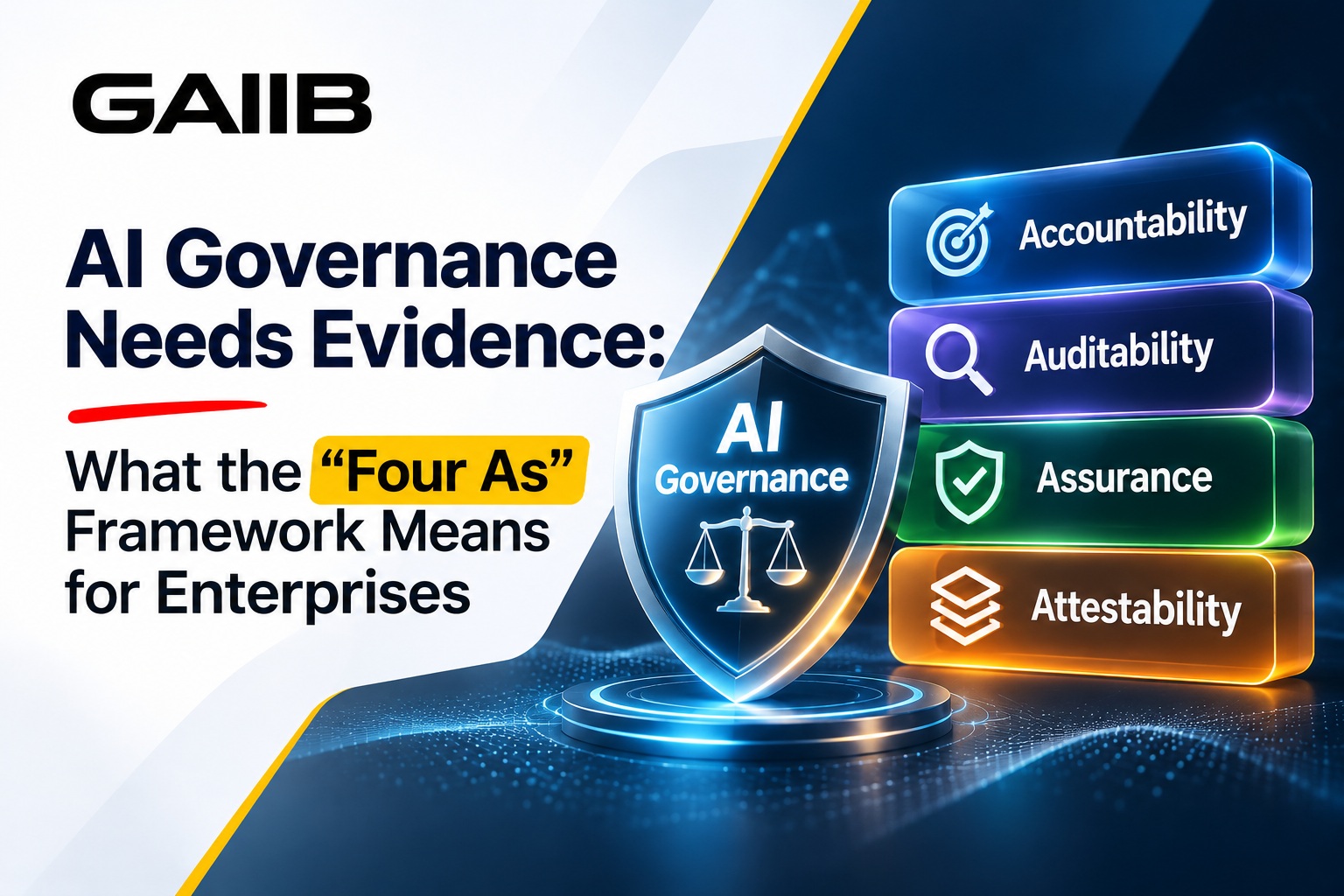
Dr Kirti Prakash and Dr Ian van der Linde argue that slowing development is an incomplete goal.
AI capability is not confined to one company or country, and existing models can be copied and improved without training new ones. Their alternative is to work out exactly which ethical problem you face, then match it to the right kind of governance.
They call it the "Four As" framework. This post explains it in plain language, shows where enterprises sit in the picture, and explains why every business that lets AI make decisions needs more than a policy. It needs proof.
What are the Four As of AI governance?
The framework breaks AI risk into four separate questions: Action, Access, Authority and Allocation.
Action asks: can humans effectively constrain consequential AI action? This is mainly owned by developers.
Access asks: who should be allowed to obtain or use potentially harmful AI capabilities? This is mainly owned by regulators.
Authority asks: which consequential judgments may be delegated to AI? This is mainly owned by deploying institutions.
Allocation asks: how are AI's benefits, burdens and power shared? This is mainly owned by governments and public bodies.
Two ideas make the framework practical. First, for any safeguard, ask what constraint is needed, who enforces it, what signal shows it has failed, and what corrective action should follow. Second, check for ripple effects: a fix in one area can create a new problem in another. Restricting access to a powerful model, for example, can concentrate power in a few firms.
The part that lands on your desk: Authority
If you run a bank, NBFC, insurer, hospital or fintech, you are not building frontier models. You are deploying AI that approves loans, flags fraud, prices policies and triages patients. In the framework's terms, you own Authority: you decide which judgments an AI system is allowed to make.
Deciding is the easy half. The hard half is showing, decision by decision, that the AI stayed inside the authority you gave it.
A policy states your intent. It cannot tell a regulator what your AI did on Tuesday at 14:32, or produce the record for decision 47,832. That takes an AI decision audit trail: a timestamped record, created when the decision happens, that nobody can quietly edit afterwards.
Why "show me" is becoming the standard regulator question
Supervisors are moving from "do you have a policy?" to "show me."
- India's DPDP Act: the main obligations apply from 13 May 2027, with penalties of up to ₹250 crore for failing to maintain reasonable security safeguards.
- RBI model risk draft (24 June 2026): it covers AI and ML models, proposes a board-approved risk framework, and expects mechanisms to override, suspend or deactivate models. It is still a draft.
- EU AI Act: the high-risk deadlines have moved later under the agreed Digital Omnibus, but record-keeping expectations for high-risk systems remain.
Across all three, the common thread is AI compliance evidence you can produce on demand.
What good Authority control looks like
The researchers' chain (constraint, enforcement, failure signal, correction) translates into six things every enterprise should be able to show:
- A defined scope for each AI system: what it may decide alone, and what needs a human.
- Every decision recorded when it happens, not reconstructed later.
- Tamper-evident records, so any later edit is detectable.
- A failure signal: an alert when a decision breaks a rule or drifts outside its scope.
- A corrective-action trail: proof of what happened after the alert.
- Independent verification, so an auditor can check the record without simply trusting you.
Where GAIIB fits: the AI Trust Gatekeeper
GAIIB™ is built for exactly this evidence layer. It is an AI governance platform that acts as an AI Trust Gatekeeper for every AI output:
- One API call after your model's output. No SDK and no change to your architecture.
- No raw personal data. Your application sends compliance signals such as consent status, data-category labels and jurisdiction codes, not names or financial records.
- A tamper-proof AI audit trail. Each decision is sealed in a SHA-256 hash chain anchored on Polygon, so any change breaks the chain.
- Flags and alerts. Non-compliant decisions are flagged, the ZeroCore™ badge is degraded, and alerts fire, which gives you a chance to correct before a regulator asks.
- Evidence in about 60 seconds for any single decision, with a read-only Auditor Access Portal for independent verification.
Disclosure & Sources:
The Four As are the researchers' work. GAIIB is not affiliated with the authors, and they have not reviewed GAIIB. This mapping is our interpretation.
- Prakash, K. and van der Linde, I., "Beyond the AI slowdown: the four As for governing frontier AI," AI and Ethics (2026), DOI 10.1007/s43681-026-01449-w. Coverage by Anglia Ruskin University via Science X, 29 October 2026.
- DPDP Rules timeline and RBI draft Guidance on Regulatory Principles for Model Risk Management (24 June 2026). Check the latest status before relying on the dates above.