
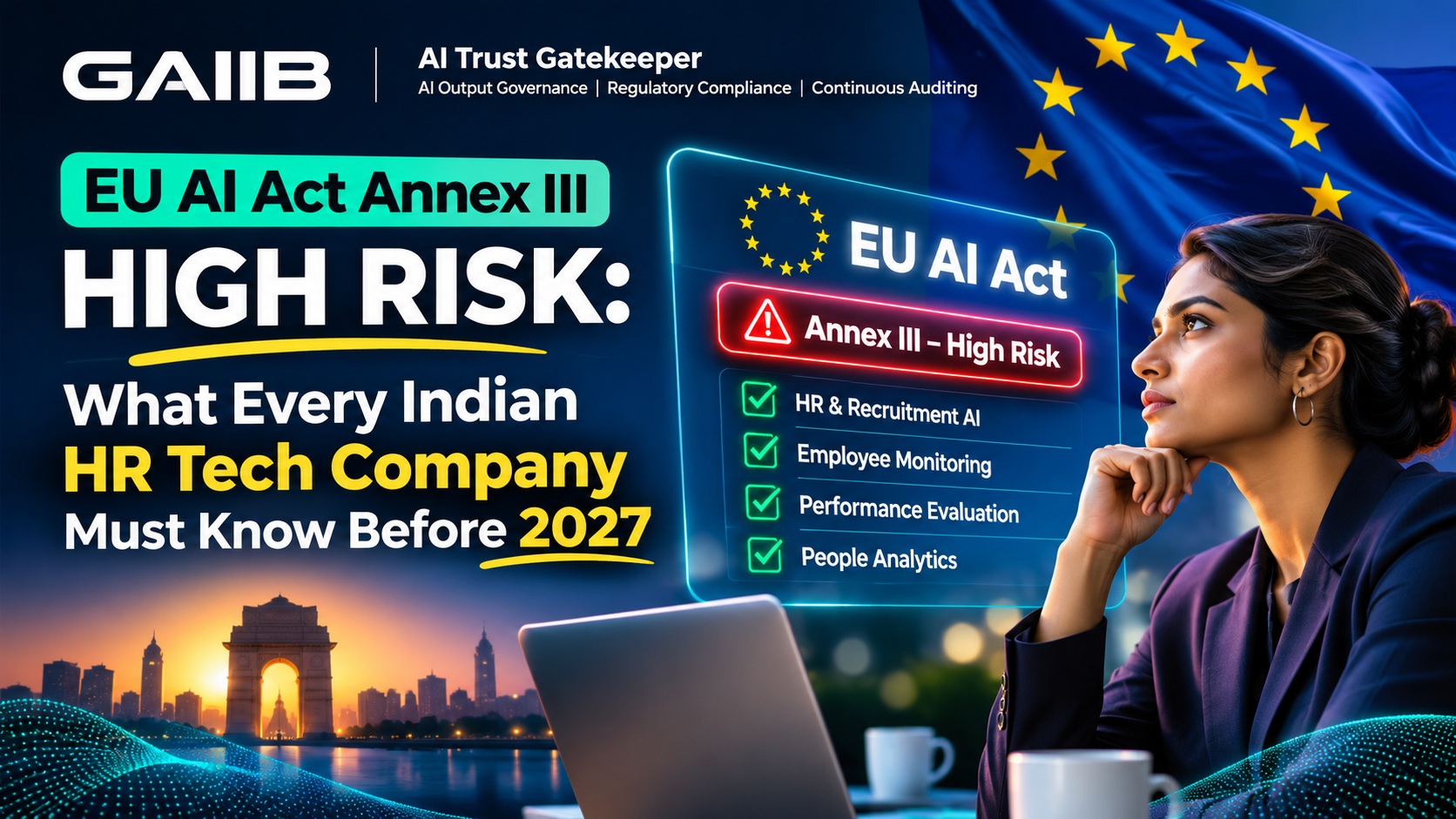
What Annex III Actually Covers for Employment
The EU AI Act's Annex III classifies AI systems used in employment, workers management, and access to self-employment as HIGH RISK. The specific applications covered include AI systems used for recruitment or selection of natural persons, for making decisions affecting working conditions, for task allocation monitoring, and for performance evaluation and promotion decisions.
Stand-alone Annex III systems — recruitment tools, credit scoring, education, law enforcement — now face full compliance on 2 December 2027. The Omnibus deferred the high-risk regime but the risk-based architecture itself was never on the negotiating table. #site_title
The December 2027 deadline does not mean the requirements are light. It means you have 15 months to build compliance infrastructure that, if you start building it now, will be production-ready when the deadline arrives. If you start building it in October 2027, you will miss the deadline.
The Scale of the Exposure for Indian HR Tech
Indian HR tech companies have significant European market exposure. Products like applicant tracking systems, video interview assessment tools, psychometric AI platforms, and workforce management software are deployed across European enterprises. If your product uses AI to rank, score, or filter candidates — and if those candidates are in the EU — your product is subject to Annex III HIGH RISK requirements.
The penalty for non-compliance is up to €30 million or 6% of global turnover, whichever is higher. For a growth-stage Indian HR tech company with €10 million in annual revenue, 6% of global turnover is €600,000. For a company with €100 million in revenue, it is €6 million. Neither figure is theoretical.
What the Compliance Requirements Actually Mean
HIGH RISK AI systems under the EU AI Act must satisfy requirements across eight areas: risk management systems, data and data governance, technical documentation, record-keeping and logging, transparency, human oversight, accuracy and robustness, and cybersecurity.
The record-keeping requirement is the one most HR tech teams underestimate. AI systems classified as HIGH RISK must automatically record logs to the extent necessary to ensure that the output can be traced back to its inputs. For a candidate screening AI, this means that for every candidate ranked or filtered, there must be a log showing what inputs were used, what the system's output was, and what regulatory compliance signals were evaluated.
This is not a post-event audit. It is a continuous, per-decision evidence requirement. For every resume your AI screens, for every interview your AI assesses, for every candidate your AI ranks — a governance record must be generated at the moment of the decision.
The NYC Local Law 144 Precedent
Before the EU AI Act deadline arrives in December 2027, Indian HR tech companies with US market exposure should note that New York City's Local Law 144 on Automated Employment Decision Tools is already in force.
Local Law 144 requires employers and employment agencies using Automated Employment Decision Tools in New York City to conduct annual bias audits, publish the results publicly, and notify candidates before using automated tools to evaluate them. It applies to any AI tool used to "substantially assist or replace" human decision-making in employment decisions.
The precedent established by NYC Local Law 144 — that AI employment tools require documented bias assessment, public disclosure, and candidate notice — is the direction every major regulatory framework is heading. The EU AI Act takes it further. The Indian HR tech companies that build their compliance infrastructure to EU AI Act HIGH RISK standards will be ahead of every comparable requirement anywhere in the world.
The DPDP + EU AI Act Dual Requirement
For Indian HR tech companies operating in both India and the EU, the compliance requirement is compound. Under DPDP, every AI processing decision about a job candidate requires valid consent, purpose limitation, and per-decision evidence of compliance. Under the EU AI Act, the same AI system requires technical documentation, risk management, and automatic logging for every evaluation.
These requirements are not identical. But they are architecturally compatible. A per-inference evidence infrastructure that captures consent signals, data category flags, and compliance verdicts for each AI employment decision satisfies the core evidence requirements of both frameworks simultaneously.
The Enterprise Procurement Reality
Indian HR tech companies that sell to large enterprises — banks, insurance companies, healthcare systems, government bodies — are facing an increasingly common procurement question: does your AI have documented governance against EU AI Act HIGH RISK requirements?
This question is being asked today, 15 months before the formal compliance deadline. Enterprise procurement teams are building AI governance requirements into vendor contracts now. A ZeroCore™ Certified badge on an HR tech platform — showing that every AI employment decision is continuously governed and evidenced — answers the procurement question before it delays or blocks the sale.
The companies that achieve AI governance certification first will win enterprise deals over competitors who are still building their compliance infrastructure. The December 2027 deadline is the regulatory floor. Enterprise procurement standards are already operating above it.